Evacuation of residents from the Chernobyl disaster zone
Voices from ChernobylThe Evacuation of residents from the Chernobyl disaster zone was not a single departure with a single meaning: in the testimonies it is at once a mass operation, a bewildering interruption of daily life, and a separation from homes, graves, animals, and neighbors whose consequences did not end when people were transported away. The accounts set the organized movement of buses and soldiers against residents’ uneven understanding of the danger and their sharply unequal ability to resist or recover.
Announcement and departure
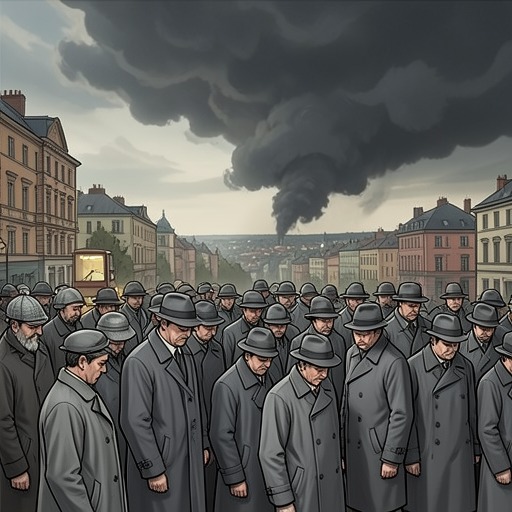
In Pripyat, the evacuation took shape against a surreal street scene. Hundreds of buses waited on one side; hundreds of fire trucks stood on the other, and white foam covered the road. Radio announcements prepared residents for an absence of only three to five days, with warm clothing for a stay in forest tents. Some people treated the prospect like an unexpected outing, getting barbecues, guitars, and radios ready, while women whose husbands had been at the reactor understood the crisis differently and cried. Their fear was informed by intimate knowledge of what had happened at the plant, even as the public instructions presented the move as temporary.
One resident recalled leaving Pripyat on the third day after the reactor caught fire. An evacuation announcement had forbidden people to take their cats, and she tried to put hers in a suitcase; the animal climbed out and scratched those around it. She could not take her possessions, but she could not accept leaving her apartment door. It was a family relic and the surface on which her father had lain before his coffin arrived. Marks on the wood recorded her school years and the growth of her children. For her, departure threatened not simply the loss of a dwelling but the abandonment of a material record of family life.
The departure from villages also carried conflicting signals. One family learned after a kolkhoz meeting that evacuation was to begin the next day, but had not yet dug up its potatoes. Neighbors sat down for a drink and condemned the kolkhoz chairman; they insisted they would not leave, even if they had to be buried there. Another resident remembered taking soil from her mother’s grave in a small sack and kneeling to ask forgiveness for leaving. People wrote their names on houses, fences, and asphalt. The markings turned departure into an attempt to leave evidence behind, as if a name or a plea could preserve a connection to a place being emptied.
Orders, resistance, and unequal vulnerability
The testimonies do not describe the evacuation as voluntary for everyone. One older woman remembered aircraft flying low toward the reactor while residents were being removed. Soldiers knocked and asked whether she had packed. She refused to leave, warning them not to try to force her. She stayed inside her hut as shouting gave way to a sudden quiet. Outside, she later learned, people had been walking in one column and livestock in another; soldiers lifted elderly women who were begging on their knees and put them into cars. Her account places one person’s refusal beside the physical force used to move others.
Other residents remembered military machines rolling in and soldiers chasing people out. One elderly man was already on the ground, dying, and said he would get up and walk to the cemetery himself. For those who had lived through war, aircraft, helicopters, trucks, and soldiers made evacuation look like the beginning of another war. Such comparisons did not mean residents understood the invisible hazard; they show how familiar images of armed conflict supplied a language for a danger they could not see.
Displacement could also become prolonged and precarious. One resident recounted walking for two weeks with a cow and sleeping in the forest because she was not allowed into the house. An account of a village woman named Anna Sushko describes a different form of vulnerability: mute from birth, unable to read, and living alone, she was put into an ambulance during the transfer and taken somewhere unknown. Neighbors who had brought her wood and milk later returned to their houses, but had no address for her and no way to find out where she had been placed. The evacuation’s administrative movement could therefore separate people from the informal care networks that had made solitary life possible.
The abandoned home and the living left behind
The promise that residents would return after a short absence gave way to years of uncertainty. An older woman recalled that no one had said the departure was forever; she waited for people to come back, then found herself living alone for years in an emptied village. She stayed near her husband’s grave and the graves of her mother and little daughter, speaking with the dead as she did with the living. For her, attachment to the village was inseparable from the people buried there, not simply from the house she occupied.
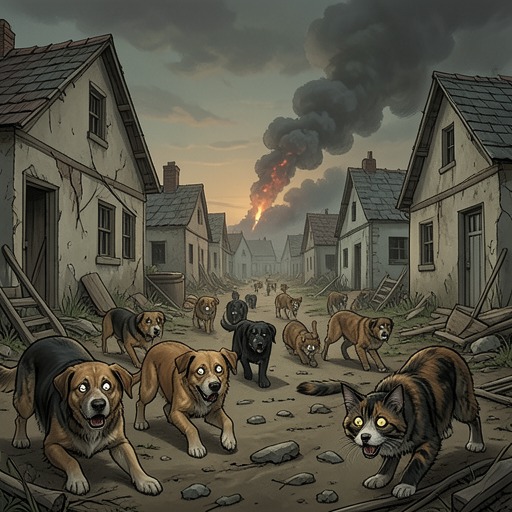
The evacuation also reordered relations with animals. Residents recalled soldiers shooting dogs, an act that left one witness unable to bear the sound of a living creature screaming. In an abandoned house, another witness found a real cat on the windowsill, not the clay ornament it first appeared to be. Notes left on doors asked people not to search for valuables, asked houses to forgive their departing occupants, or pleaded with whoever found them not to kill a family cat. The notes document attempts to protect domestic life after the people who had tended it were gone. They also make visible how an instruction to leave could not guarantee the safety of those left behind.
After departure
Evacuation did not produce a common experience of secure resettlement. For some, the loss included exclusion from ordinary social life: a former resident of Pripyat described how people looked at evacuees as if they were animals, questioned them about the burning station, and treated the word Chernobyl as a signal marking them as different. A mother’s account of her daughter’s repeated operations, long residence in hospital, and need for extensive care shows how a family’s life after displacement could be organized around medical treatment and the search for help. After four years of refusals, doctors finally provided a paper confirming a connection between low-dose ionizing radiation and the child’s condition. The evacuation belongs to a much longer aftermath in which families had to seek recognition and resources as well as shelter.
Other testimony describes the collapse of basic support in affected rural areas: kindergartens lost their cooks and nurses, children went hungry, and a patient needing an appendectomy had to be driven sixty kilometers to another region because surgeons had left. These details resist the idea that removal alone solved the crisis. Access to care, the ability to keep family members together, and the chance to make a new home all shaped what evacuation meant in practice.
The book also follows the abandoned territory into a later period, when refugees from Armenia, Georgia, Abkhazia, Tajikistan, and Chechnya came to live in unburied, unruined houses. For people fleeing gunfire, warnings about poisoned land, water, and air could sound less immediate than the violence they had already escaped. The movement of residents away from the disaster zone thus did not end with empty villages: some places were later occupied by people displaced by other wars. Across these accounts, evacuation is both a physical transfer and an unfinished separation, measured in missing neighbors, inaccessible homes, graves left behind, and the different dangers people were forced to weigh.